
Kiwi.com Self-Transfer: Booking Tactics and Risks (2026)
✈️ Flight Hack Spec Card
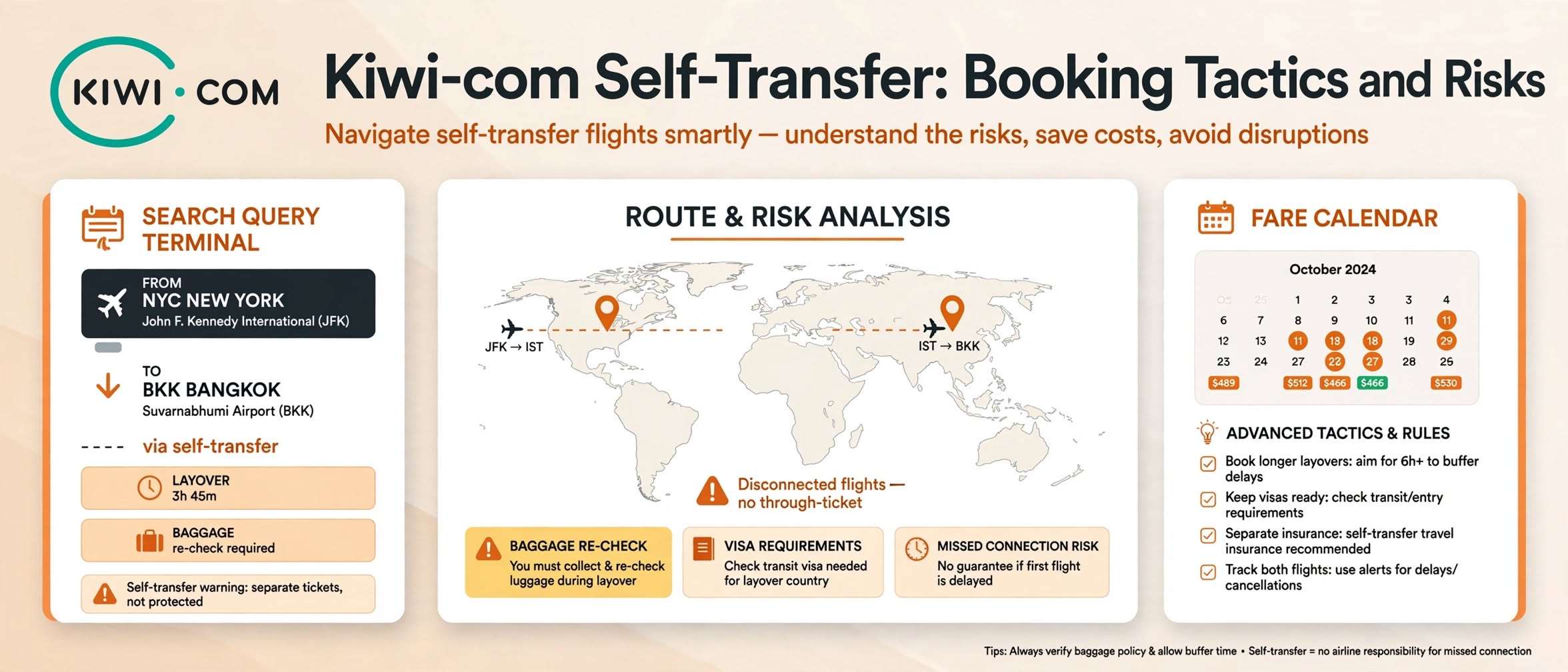
Quick Steps & Summary
Full Flight Hack Guide
Quick Answer (TL;DR)
Kiwi.com combines flights from airlines that do not cooperate, a method called virtual interlining. This can create cheap routes, but on a self-transfer itinerary the airlines are not responsible if a delay makes you miss your next flight. Kiwi offers the Kiwi.com Guarantee for these cases, so read its terms, check baggage and visa rules, and leave long layovers.
---
What Is Virtual Interlining and How Does Kiwi Find Cheap Routes?
On a traditional connecting ticket, the airlines cooperate. When both flights are on one reservation, your bags are usually checked through, and the airline normally helps if a delay makes you miss the second flight. Your rights depend on the airline, the route, and local rules.
Kiwi's search technology combines flights from independent airlines that do not have such agreements. This is called virtual interlining. Kiwi books the flights for you, but each flight is a separate ticket with its own airline rules.
Search Tools on Kiwi:
For destination ideas before you build a multi-city route, try our Skyscanner Everywhere guide.
For a web-based option with a date grid and price tracking, see our Google Flights hidden features guide.
---
The Self-Transfer Trap: What Happens When a Connection Fails?
When an itinerary on Kiwi is marked as a self-transfer, you are purchasing two or more independent tickets.
If your first flight is delayed or cancelled, the second airline is generally not required to help. It may treat you as a no-show and not offer a new seat or a refund. The airlines are responsible only for their own flights.
A self-transfer can also mean extra steps:
Kiwi has noted that if a self-transfer is too short, it may not offer checked baggage at all because there would not be enough time to recheck it.
---
What the Kiwi.com Guarantee Covers
Kiwi offers the Kiwi.com Guarantee (including Connection Protection and similar services) as a way to cover disruptions on self-transfer itineraries.
Limits apply. Kiwi states that you remain responsible for valid travel documents, and a missed connection caused by delayed baggage you added directly through the airline may not be protected. Kiwi's terms are binding, so read them before you pay.
---
Smart Booking Tactics
1. Use long layovers: Allow a generous buffer, especially for international trips, terminal changes, or baggage rechecks. A longer layover is usually safer than the cheapest option.
2. Prefer same-airline or single-ticket routes when the price is close: A single reservation gives you more protection than separate tickets.
3. Travel light when you can: Carry-on only avoids recheck problems, but check each airline's cabin rules.
4. Check visas early: Find out whether you need to enter the layover country.
5. Compare the total price: Include Guarantee, bags, and service fees, and compare with a single-ticket alternative.
6. Keep records: Save screenshots of the itinerary, Guarantee terms, and confirmations.
7. Consider travel insurance: Check whether it covers missed connections on separate tickets.
If you also compare other search engines, see Momondo vs Skyscanner vs Kayak. For another service with paid protection and fine print, read our Hopper Price Freeze guide.
---
Kiwi Self-Transfer vs. Single-Ticket Booking
| Feature | Kiwi self-transfer | Single ticket (same reservation) |
|---|---|---|
| Price | Can be lower | Often higher |
| Airline help if you miss the connection | Generally no | Usually yes |
| Baggage | You may need to recheck | Usually checked through |
| Extra protection | Optional Kiwi.com Guarantee | Airline's own policies |
| Visa or transit needs | May apply if you must leave the transit area | Often not needed |
| Best used for | Flexible, price-focused travelers | Tight schedules and peace of mind |
If you prefer to research complex routes without booking fees, see our ITA Matrix routing codes guide.
---
Pitfalls and Red Flags to Avoid
---
Pro Traveler Checklist
---
Frequently Asked Questions
What is a self-transfer on Kiwi.com?
A self-transfer means your itinerary includes separate tickets, often with different airlines that do not cooperate. You may need to collect and recheck baggage, change terminals, or pass security again. If a delay makes you miss the next flight, the airlines are generally not responsible for rebooking you.
What is the Kiwi.com Guarantee?
It is a package of disruption services that Kiwi offers for itineraries, especially self-transfers. If a covered delay or cancellation happens, Kiwi may help with another flight or compensation, sometimes as Kiwi.com Credit. Check the current terms, limits, and cost at checkout before you rely on it.
Do I need a transit visa for a self-transfer?
Possibly. If you must leave the secure transit area to recheck bags, check in, or change terminals, you may need the same entry documents as if the layover country were your final destination. Check visa rules before booking, because documents are your responsibility.
Is Kiwi.com legit and safe to use?
Kiwi.com is an established online travel agency, but its self-transfer model is more complex than a single ticket, and reviews often mention service and refund issues. Read the terms, check recent reviews, keep screenshots, and compare the final price with booking directly.
Should I book on Kiwi.com or with the airlines directly?
It depends on price and risk tolerance. Kiwi can find routes that other sites do not show, but a single ticket gives more protection. A common approach is to use Kiwi to discover routes, then compare the total cost, including bags and Guarantee fees, with direct options.
---
Final Verdict
Kiwi.com can unlock cheap routes through virtual interlining, but self-transfer itineraries put the responsibility on you. Leave long layovers, check baggage and visa rules, read the Kiwi.com Guarantee terms, and compare the total cost with a single-ticket option before you book.
Next step: Run one of your upcoming routes on Kiwi.com and on a single-ticket option, compare the total cost and layover length, and decide whether the saving is worth the risk.
---