
Are City Tourist Passes Worth It? Break-Even Math (2026)
🎟️ Free City Guide Quick Overview
Top Free Highlights & Quick Overview
Full City Guide & Free Attractions
Disclosure: Some links in this article may be affiliate links. If you book through them, we may earn a commission at no extra cost to you.
---
Quick Answer (TL;DR)
A city pass can be a smart purchase, but only if it matches the way you actually travel.
A lot of people buy a pass after seeing a long list of included attractions, then realize later they only used a small fraction of them. The result? They spend more than they would have on individual tickets.
The easiest way to decide is to ignore the marketing and focus on your real itinerary. Make a list of the attractions you genuinely want to visit, add up the current ticket prices, and compare that total with the cost of the pass.
If the pass costs less and fits your schedule, it may be worth it. If most of your trip revolves around free museums, local neighborhoods, parks, markets, and wandering around the city, buying separate tickets is often the cheaper and more flexible option.
---
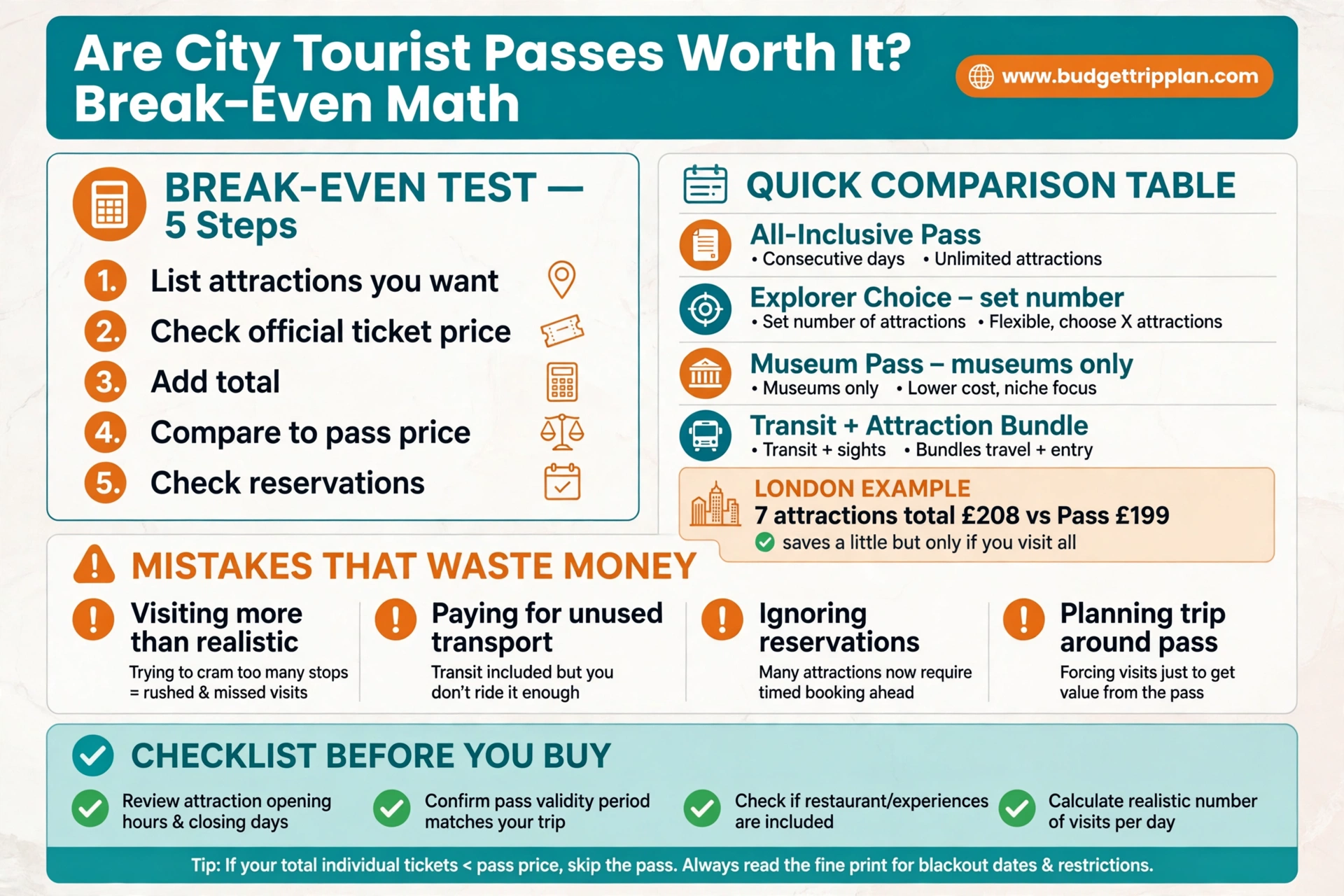
Quick Comparison: City Pass Types (2026)
| Pass Type | How It Works | Best For | Main Drawback |
|---|---|---|---|
| All-Inclusive Pass | Access to participating attractions over a fixed number of consecutive days | Travelers planning multiple paid attractions daily | Easy to overestimate how much you can fit into a day |
| Explorer / Choice Pass | Includes a set number of attractions used over a longer period | Travelers wanting flexibility and a slower pace | Savings depend heavily on which attractions you choose |
| Museum Pass | Covers participating museums for a fixed period | Museum-focused travelers | Limited value if you only visit a few museums |
| Transit + Attraction Bundle | Combines transportation with attraction access or discounts | Visitors using public transport frequently | Paying for transport benefits you barely use |
Pass inclusions, pricing, reservation rules, and attraction availability can change throughout the year. Always verify details directly with the pass provider before purchasing.
---
1. The Real Question: Are You Actually Saving Money?
When people ask whether a city pass is worth buying, they're usually asking the wrong question.
The better question is:
"Would I have spent this money anyway?"
That's because a pass only creates value if it replaces expenses you were already planning to have.
For example, imagine a traveler visiting London for three days. They want to see the Tower of London, Westminster Abbey, St Paul's Cathedral, and a few other paid attractions. A pass may work well because those attractions already match their plans.
Now imagine another traveler who plans to spend most of the trip exploring neighborhoods, browsing markets, relaxing in parks, and visiting free museums. The exact same pass may provide very little value because many included attractions were never part of the itinerary.
The pass itself isn't good or bad. It depends entirely on how you plan to use it.
---
2. Why Tourist Passes Feel More Valuable Than They Sometimes Are
Tourist pass websites are designed to highlight the maximum possible savings.
You'll often see claims like:
While technically true, very few travelers visit every attraction available.
In reality, most visitors have limited time, varying interests, and different energy levels.
After several hours of sightseeing, many travelers prefer:
Those slower moments often become the most memorable parts of a trip, even though they're not included in any city pass.
That's why it's important to evaluate a pass based on your actual travel habits rather than its marketing brochure.
---
3. Understanding the Different Pass Types
Not every city pass works the same way.
Many travelers end up buying the wrong type simply because they focus on the headline discount instead of how the pass is structured.
All-Inclusive Passes
These passes allow access to participating attractions during a set number of consecutive days.
They usually work best for travelers who:
A well-planned itinerary can sometimes make these passes worthwhile, particularly in cities where attraction tickets are expensive.
The downside is that they often encourage rushing from place to place just to maximize value.
Explorer or Choice Passes
Explorer-style passes offer a fixed number of attractions rather than unlimited visits.
For many travelers, this feels more realistic.
You can choose the experiences that matter most while keeping the rest of your schedule flexible.
These passes usually work well for:
Instead of trying to squeeze six attractions into one day, you can focus on a few experiences and enjoy them at a more comfortable pace.
---
4. Convenience Has Value Too
The break-even math matters, but it isn't the only factor.
Some travelers happily pay a little extra because a city pass makes planning easier.
Benefits may include:
Others prefer complete flexibility and don't mind buying tickets individually as they go.
Neither approach is wrong.
The important thing is understanding exactly what you're paying for.
Sometimes the biggest benefit isn't the discount. It's the convenience.
---
5. The Most Common Mistake Travelers Make
The biggest mistake isn't choosing the wrong pass.
It's changing your trip simply to justify the pass you've already purchased.
A lot of travelers buy a pass first, then feel pressured to visit attractions solely because they're included.
That can lead to packed schedules, sightseeing fatigue, and less time enjoying the city itself.
Instead, build your itinerary first.
Decide what you actually want to see.
Once that's done, look at the available city passes and ask whether any of them reduce your costs.
That simple change in thinking often leads to better travel decisions and less wasted money.
---
> BudgetTripPlan Tip: Before buying any city pass, pretend it doesn't exist. Plan your ideal trip first. Once you know exactly which attractions you want to visit, compare the cost of individual tickets with the price of the pass. You'll usually make a better decision than someone who starts with the pass and builds their trip around it.
---
6. The Break-Even Math: The Calculation That Actually Matters
Most city pass decisions come down to one simple question:
"Will I spend more on individual tickets than I would on the pass?"
That's it.
The problem is that many travelers start by looking at everything included in the pass instead of focusing on the attractions they genuinely want to visit.
A better approach is much simpler.
1. Make a list of the attractions already on your itinerary.
2. Check the official ticket price for each one.
3. Add up the total cost.
4. Compare that number with the pass price.
5. Check whether reservations are required and if your preferred times are still available.
Once you've done that, the answer usually becomes obvious.
If the pass clearly costs less, it may be worth buying.
If the difference is small, convenience becomes the deciding factor.
If the pass costs more than your planned attractions, you're probably better off purchasing tickets separately.
> BudgetTripPlan Tip: Don't include attractions just because they're part of the pass. If you wouldn't pay to visit them otherwise, they shouldn't be part of your calculation.
---
7. Choosing Between All-Inclusive and Explorer Passes
One of the biggest mistakes travelers make is buying the wrong type of pass.
Many people see the largest advertised discount and assume it's automatically the best deal.
In reality, the best pass is the one that fits your travel style.
All-Inclusive Passes
All-inclusive passes typically give access to participating attractions during a specific number of consecutive days.
They tend to work best for travelers who:
For example, if you're spending three packed days in London, New York, or Paris and plan to visit several major attractions each day, an all-inclusive pass may provide decent value.
The downside is that many travelers overestimate how much sightseeing they can realistically fit into a day.
What looks achievable on paper often feels exhausting in practice.
Explorer or Choice Passes
Explorer-style passes usually allow you to choose a certain number of attractions and visit them over a longer period.
These passes are often a better fit for travelers who:
Rather than rushing between museums and landmarks, you can focus on a few experiences and enjoy the city at a more comfortable pace.
For many visitors, this type of pass strikes a better balance between convenience and value.
---
8. London Example: A Realistic 3-Day Calculation
London is one of the easiest cities to use as an example because it has both expensive attractions and fantastic free alternatives.
Let's imagine a traveler plans to visit:
| Day | Attraction | Example Adult Ticket Price |
|---|---|---|
| Day 1 | Tower of London | £37 |
| Day 1 | Westminster Abbey | £32 |
| Day 1 | Tower Bridge | £18 |
| Day 2 | London Zoo | £38 |
| Day 2 | Thames River Cruise Option | £25 |
| Day 3 | St Paul's Cathedral | £27 |
| Day 3 | Shakespeare's Globe Tour | £31 |
| Total | Estimated Ticket Cost | £208 |
Now imagine a city pass costs around £199.
Technically, the pass saves money.
But only a little.
For some travelers, saving a small amount while having one digital pass is still worthwhile.
Others would rather keep complete flexibility and purchase tickets separately.
Now consider a different itinerary.
Instead of focusing on paid attractions, you spend time at:
Many of those experiences are free.
In that scenario, the value of a city pass drops quickly because you're no longer using enough paid attractions to justify the cost.
London Verdict
A city pass can absolutely work in London.
But it generally works best for travelers planning several paid attractions rather than those building a trip around free museums, parks, neighborhoods, and markets.
The lesson applies to almost every major city.
Don't buy a pass because it's available.
Buy it because the math supports the purchase.
---
9. Four Tourist Pass Mistakes That Waste Money
Mistake #1: Believing You'll Visit More Attractions Than You Actually Will
This is probably the most common mistake.
Before a trip, it's easy to imagine visiting six or seven attractions every day.
Once you're actually traveling, things change.
You stop for coffee, get distracted by a neighborhood, spend longer at a museum than expected, or simply decide to slow down and enjoy the city.
Always build your calculations around realistic plans rather than ambitious ones.
Mistake #2: Paying for Features You Won't Use
Transport upgrades and additional benefits often sound impressive.
But if you're staying in a walkable city center, you may hardly use public transportation at all.
Don't pay extra for features simply because they look useful.
Pay for them because you know you'll use them.
Mistake #3: Ignoring Reservation Requirements
Many travelers assume that owning a pass guarantees entry.
It doesn't.
Popular attractions often require advance reservations, even for pass holders.
Before purchasing, verify that the attractions most important to you have available time slots.
Mistake #4: Planning Your Trip Around the Pass
A city pass should support your itinerary.
Your itinerary shouldn't exist to justify the pass.
The best trips are usually built around your interests, not around squeezing value from a prepaid sightseeing product.
---
10. A Simple Checklist Before You Buy
Before spending any money on a tourist pass, ask yourself:
If most answers are yes, the pass may be a smart purchase.
If several answers are no, individual tickets often remain the better option.
In the end, city passes aren't about chasing the biggest advertised discount.
They're about paying less for the attractions you already planned to visit.
---
Frequently Asked Questions (FAQ)
Are city tourist passes actually worth buying?
Sometimes they are, and sometimes they aren't.
A city pass makes the most sense when the attractions already on your itinerary would cost more if purchased separately. If most of your trip will be spent visiting free museums, exploring neighborhoods, relaxing in parks, or wandering local markets, buying individual tickets is often the cheaper option.
The value comes from your itinerary, not from the number of attractions listed on the pass.
How can I tell if a city pass will save me money?
The easiest method is also the most reliable.
Make a list of the paid attractions you genuinely want to visit, check the current ticket prices, and add them together. Then compare that number with the pass price.
If the pass costs less and includes the attractions you care about most, it may be a good deal. If not, separate tickets are usually the safer choice.
Do city passes help you skip lines?
Sometimes, but not always.
Many passes let you avoid buying tickets on-site, which can save time. However, attractions may still require:
A city pass can reduce some waiting, but it shouldn't be viewed as a guaranteed "skip every line" solution.
Can multiple people use the same city pass?
Generally no.
Most city passes are designed for a single traveler and are connected to a specific QR code, account, mobile app, or booking record. Sharing passes between different people is usually not allowed.
Always check the pass provider's terms before purchasing.
What if my plans change after buying a pass?
That depends on the provider.
Some passes allow cancellations before activation, while others have stricter rules. Reservation requirements can also affect flexibility.
Before paying, check:
A few minutes of research can help avoid expensive surprises later.
Are online city pass discounts always the best deal?
Not necessarily.
Promotions change frequently, and some attractions offer their own discounts, bundled tickets, or seasonal offers.
It's worth comparing:
Never assume that a product labeled "discounted" is automatically the cheapest option.
What's the biggest city pass mistake first-time travelers make?
Buying the pass first and planning the trip later.
A much smarter approach is to create your itinerary first, then check whether a pass reduces your costs.
When travelers reverse that process, they often feel pressured to visit attractions they weren't interested in just to justify the purchase.
---
Final Verdict
A city tourist pass is neither a guaranteed bargain nor a guaranteed waste of money.
It's simply a tool, and like any tool, its value depends on how you use it.
For travelers planning several paid attractions in a short amount of time, a pass can sometimes reduce costs and simplify trip planning. For travelers who prefer a slower pace, enjoy free attractions, and value flexibility, separate tickets often make more financial sense.
The smartest approach isn't complicated.
First, build the trip you actually want.
Then check the prices of the attractions that matter to you.
Finally, compare that total with the cost of the pass.
If the numbers work in your favor, buy the pass.
If they don't, keep your money and purchase tickets individually.
Either way, you'll be making a decision based on your travel plans instead of a marketing promise.
Next Step:
Before your next city break, write down the five paid attractions you most want to visit. Add up the ticket prices and compare them to the city's pass options. That simple five-minute exercise usually tells you more than pages of advertising ever will.
---
Related Reading
---