
How Free Walking Tours Work: Tipping & Platforms (2026)
🎟️ Free City Guide Quick Overview
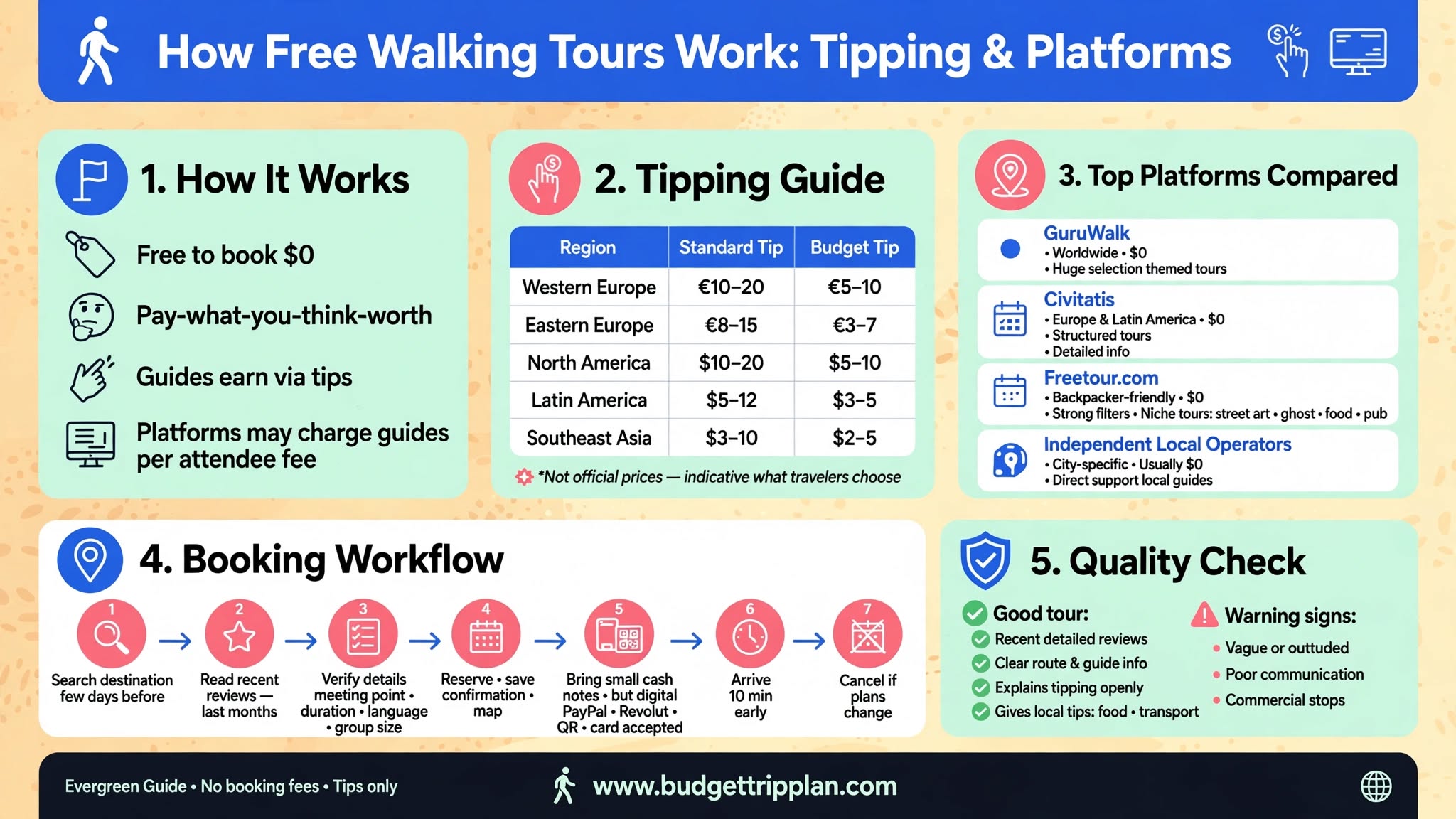
Top Free Highlights & Quick Overview
Full City Guide & Free Attractions
Disclosure: Some links in this article may be affiliate links. If you book through them, we may earn a commission at no extra cost to you.
---
Quick Answer (TL;DR)
The short answer is simple. You don't pay anything upfront when you reserve your place, but guides typically earn their income from the tips travelers leave at the end of the tour.
In many destinations, travelers often contribute somewhere around €10–€20 per person for a good experience, although local costs, group size, tour length, and overall quality can all influence that amount. Some platforms display broader suggested ranges, but there is no fixed rule.
Before booking, spend a few minutes checking reviews, cancellation policies, group-size limits, and meeting-point details. A little research can help you avoid disappointment and find a guide who genuinely improves your understanding of a city.
---
Quick Comparison: Top Free Walking Tour Platforms (2026)
| Platform | Best Known For | Traveler Booking Fee | Key Feature |
|---|---|---|---|
| GuruWalk | Worldwide coverage | $0 | Huge selection of local and themed tours |
| Civitatis | Europe & Latin America | $0 | Structured tours and detailed information |
| Freetour.com | Backpacker-friendly travel | $0 | Strong filtering system and niche tours |
| Independent Local Operators | City-specific expertise | Usually $0 | Direct support for local guides |
Note: Free refers to the booking process, not necessarily a completely free experience. Guides generally earn money through tips, and some platforms may charge guides fees for confirmed attendees.
---
1. The Business Model: How Free Walking Tours Actually Work
The name "free walking tour" can be slightly confusing if it's your first time booking one.
Most people assume guides are volunteers or that a tourism board pays them. In reality, most guides work independently or as part of small local tour companies and depend largely on tips from guests.
Instead of charging a fixed ticket price, free walking tours operate on a pay-what-you-think-it's-worth model.
How Guides Earn Money
Most guides spend years learning local history, planning routes, answering questions, and improving their storytelling. The free-tour model allows travelers to decide what that experience was worth once the tour ends.
For travelers, this model has one major advantage. You can join without committing to a fixed ticket price.
For guides, it creates an incentive to deliver an engaging experience because their earnings depend heavily on traveler satisfaction.
> BudgetTripPlan Tip: Think of a free walking tour as a flexible-priced tour rather than a completely free activity. If the experience adds value to your trip, tipping fairly helps experienced local guides continue offering these tours.
---
2. Tipping Etiquette: How Much Should You Tip in 2026?
This is easily the question travelers ask most often.
There is no universal amount because costs, wages, and expectations vary significantly between destinations. What feels generous in Southeast Asia may feel quite low in Western Europe.
For many travelers, the following ranges serve as a reasonable starting point.
Indicative Tipping Guide
| Region / Location | Typical Traveler Range | Budget Option |
|---|---|---|
| Western Europe | €10–€20 | €5–€10 |
| Eastern Europe | €8–€15 | €3–€7 |
| North America | $10–$20 | $5–$10 |
| Latin America | $5–$12 | $3–$5 |
| Southeast Asia | $3–$10 | $2–$5 |
These aren't official prices. They're simply examples of what many travelers choose to contribute based on destination, tour quality, and personal budget.
Factors That Influence Tips
Most guides now accept more than cash. Alongside traditional tipping, it's becoming increasingly common to see card readers, QR codes, PayPal, Revolut, or local payment apps.
3. Top Platforms to Book Free Walking Tours
While it's still possible to show up at a meeting point and join a tour, most travelers now book online first. It takes only a minute and helps guides estimate attendance more accurately.
The three biggest platforms each have slightly different strengths, so it's worth comparing options before making a reservation.
A. GuruWalk
GuruWalk has become one of the most recognizable platforms for free walking tours worldwide. In popular destinations, you'll often find multiple tours covering the same city from different perspectives.
One guide may focus on historical landmarks, while another specializes in local neighborhoods, architecture, food culture, or street art.
Why many travelers like GuruWalk:
Before booking, check whether the tour requires a minimum number of participants and look for recent reviews mentioning pacing, group size, and guide quality.
B. Civitatis
Civitatis is particularly strong in Europe and Latin America and tends to offer a structured booking experience.
The platform is often a good fit for travelers who value clear schedules, detailed meeting instructions, and well-organized tour information.
Why travelers choose Civitatis:
One detail worth noting is that many Civitatis free tours place restrictions on larger groups. Always read the booking rules carefully if you're traveling with friends or family.
C. Freetour.com
Freetour.com is especially popular among backpackers and independent travelers looking for alternatives to standard city-center tours.
Alongside traditional sightseeing walks, you'll often find:
The filtering tools are particularly useful if you're looking for something beyond the typical highlights.
Before reserving a spot, spend a few minutes reading the newest reviews rather than relying solely on overall ratings.
Which Platform Is Best?
There isn't one perfect platform for every destination.
A practical approach is to compare the same city across all three platforms and choose the guide with the strongest recent reviews, the most suitable schedule, and the route that matches your interests.
If you're visiting major budget-friendly destinations such as Madrid or Rome, compare a few options before booking.
You can also explore:
Madrid on a Budget: 3-Day Itinerary Under $175 (2026)
Rome on a Budget: 3-Day Itinerary Under $190 (2026)
These guides can help you fit a walking tour naturally into your first day of sightseeing.
---
4. Step-by-Step Booking & Attendance Workflow
Booking a free walking tour is straightforward, but a little preparation can make the experience smoother.
Step 1: Search Your Destination
Start looking a few days before arrival, especially during summer, holidays, or weekends when spots may fill quickly.
Compare several tours rather than booking the first option you see.
Step 2: Read Recent Reviews
Focus on reviews from the last few months.
Comments about storytelling, route quality, local recommendations, and organization are often more useful than simple star ratings.
Step 3: Verify Tour Details
Before confirming your reservation, check:
This step prevents most common booking problems.
Step 4: Reserve Your Spot
Complete the booking and save the confirmation email or screenshot.
Downloading the meeting point map can be helpful if mobile data is limited after arrival.
Step 5: Bring Small Cash Notes
Although digital payments are increasingly common, cash remains the easiest option in many destinations.
Small bills make tipping faster and easier at the end of the tour.
Step 6: Arrive Early
Aim to arrive about 10 minutes before departure.
Popular meeting points can be crowded, and finding the guide becomes easier if you're not rushing at the last minute.
Step 7: Cancel If Your Plans Change
This simple step is often overlooked.
If you decide not to attend, cancel your booking whenever possible. It helps guides estimate attendance and allows other travelers to join if spaces are limited.
---
5. How to Tell if a Free Walking Tour Is Worth Joining
Not all walking tours deliver the same experience.
Some guides are excellent storytellers who turn local history into something memorable. Others may simply walk a group between landmarks without providing much context.
Spending a few minutes researching beforehand usually makes a huge difference.
A quality walking tour generally:
The best guides often provide practical recommendations as well, including affordable restaurants, public transportation advice, and local neighborhoods worth exploring after the tour.
Warning signs may include:
A reputable guide should leave you feeling more connected to the city, not pressured into spending money.
---
6. Common Mistakes First-Time Travelers Make
Free walking tours are easy to join, but first-time participants often make a few avoidable mistakes.
Assuming the Tour Is Completely Free
Technically, booking costs nothing.
However, guides generally depend on tips as their primary source of income. If you've enjoyed the experience, it's fair to factor a contribution into your travel budget.
Waiting Until the Last Minute
Popular tours can reach capacity during peak travel periods.
Booking a day or two in advance usually provides more choice and greater flexibility.
Forgetting to Cancel
No-shows can create problems for guides, especially on tours with limited group sizes.
A quick cancellation is always appreciated.
Arriving Unprepared
Walking tours usually last between two and three hours.
Comfortable shoes, water, weather protection, and a fully charged phone can make the experience much more enjoyable.
Choosing Only by Rating
A tour with slightly fewer reviews may actually suit your interests better.
Read descriptions carefully and select the experience that matches your travel style instead of focusing solely on review scores.
Frequently Asked Questions (FAQ)
Are free walking tours really free?
Yes and no.
Most free walking tours don't charge an upfront booking fee, which makes them accessible to almost any traveler. However, guides usually rely on tips as their primary source of income. That's why many experienced travelers treat the tour as a "pay what you feel it's worth" experience rather than a completely free activity.
How much should I tip on a free walking tour?
There isn't a universal amount.
Many travelers in Western Europe choose to contribute around €10–€20 per person after a good tour, while amounts may be lower or higher depending on the destination, tour quality, length, and local living costs.
The most important factor is whether the experience provided value to you.
What if I don't have cash?
Many guides now accept digital payments.
Depending on the destination, you may see payment options such as:
That said, carrying a few small notes in local currency is still the safest option.
How long do free walking tours usually last?
Most standard tours last between two and three hours.
Specialized experiences focusing on history, food, architecture, or local neighborhoods may run longer.
Always check the tour description before booking.
Can I leave before the tour ends?
Yes.
If you need to leave early, simply let the guide know during a stop. If you enjoyed the portion you attended, consider leaving a proportional tip before you go.
Are free walking tours good for solo travelers?
Absolutely.
In fact, they're one of the easiest ways for solo travelers to learn about a city, meet other visitors, and receive local recommendations without spending much money.
Should I book in advance?
For popular destinations, yes.
Cities such as Rome, Madrid, Prague, Budapest, Amsterdam, and Lisbon often have tours that fill quickly during busy travel periods. Booking ahead takes only a minute and removes uncertainty.
Are free walking tours worth it?
For many travelers, they're among the highest-value activities available.
A good guide can help you understand local history, identify neighborhoods worth exploring later, avoid tourist traps, and recommend affordable food and transportation options.
---
Final Verdict
Free walking tours remain one of the smartest ways to get familiar with a new destination without committing to an expensive guided experience.
Whether you're exploring Rome, Madrid, Prague, Budapest, Bangkok, or dozens of other cities around the world, spending a few hours with a knowledgeable local guide can dramatically improve your understanding of the destination.
You'll usually learn local history, discover lesser-known areas, get practical recommendations, and gain confidence navigating the city during the rest of your stay.
The most important thing to remember is simple: the booking may be free, but the guide's work isn't.
If you enjoyed the tour, learned something new, or discovered places you might never have found on your own, leaving a fair tip helps support the people who make these experiences possible.
For many travelers, budgeting roughly €10–€20 per person for a good standard tour is a reasonable starting point, while adjusting based on local conditions and the overall quality of the experience.
Next Step:
Consider booking a free walking tour for your first morning in any new city. It's one of the fastest ways to get oriented, learn local customs, and collect insider recommendations that can save both money and time throughout your trip.
---
Related Reading
---