
How to Avoid Hidden Hotel Fees: Resort Fees & Taxes (2026)
🏨 Budget Accommodation Quick Overview
Top Stays & Quick Breakdown
Full Accommodation Guide
Disclosure: Some links in this article may be affiliate links. If you book through them, we may earn a commission at no extra cost to you.
---
Quick Answer (TL;DR)
Under the FTC's Rule on Unfair or Deceptive Fees, in effect since May 12, 2025, hotels and booking sites in the U.S. must show the total price, including any mandatory resort fee, up front. The rule requires disclosure; it does not ban or cap fees. Government taxes can be left out of that total, so city taxes, card holds, and optional add-ons can still surprise you at the desk. To avoid hidden hotel fees, compare total prices before booking, check whether local taxes are paid separately, use points at brands that waive resort fees on award stays, decline optional charges such as room safes, and pay in local currency.
---
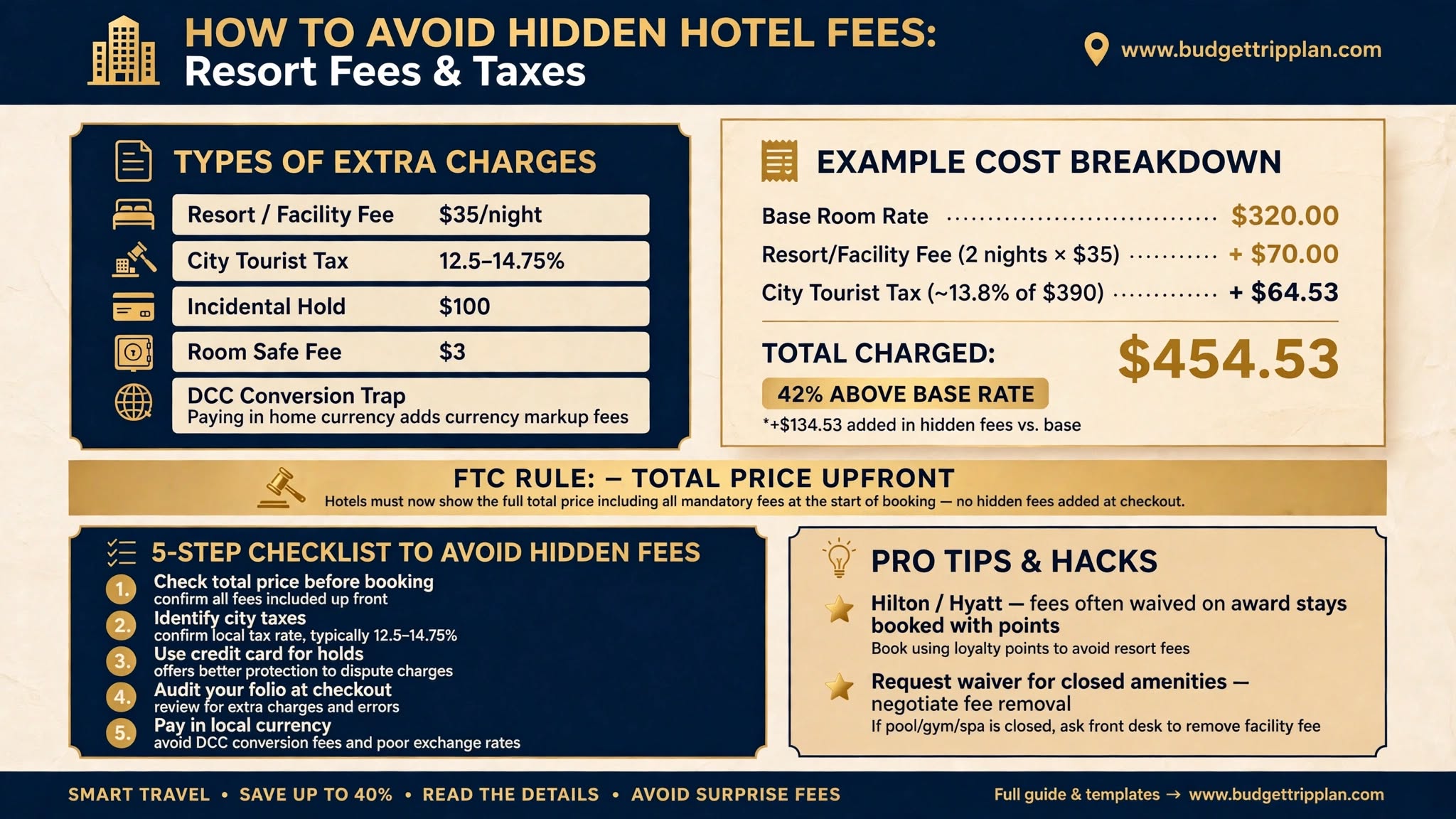
Quick Comparison: Types of Hotel Extra Charges (2026)
| Fee Type | What It Is | How It Is Charged | Can You Avoid It? |
|---|---|---|---|
| Resort / Facility Fee | Mandatory charge that may cover pool, Wi-Fi, or gym access | Per room per night | Waived on award stays at some programs (Hilton Honors, World of Hyatt); a waiver for closed amenities is possible but not guaranteed |
| City / Tourist Tax | Government levy collected by the accommodation | Per person per night or as a percentage of the room rate, depending on the city | No, it is set by local government |
| Incidental Card Hold | Temporary authorization for possible extra charges | Held on the card you give at check-in; not a charge | Not avoidable, but use a credit card instead of a debit card |
| Room Safe Fee | Daily charge for an in-room safe, where a hotel adds one | Line item on the itemized bill (folio) | Often yes: ask the front desk to remove it if you did not request it |
| Dynamic Currency Conversion (DCC) | Card terminal converts your bill into your home currency | Offered on the terminal at payment | Yes: always choose the local currency |
---
1. Mandatory Fees vs. City Taxes: What the Rules Actually Cover
Travelers often group all extra hotel charges together under "hidden fees," but understanding how they are structured helps you avoid surprises.
Mandatory Resort & Destination Fees
Hotels use names like Resort Fee, Facility Fee, Destination Fee, or Amenity Charge. Since May 12, 2025, the FTC's rule requires hotels and booking platforms to show the total price, including mandatory fees, clearly and up front. It does not cap or ban the fee itself. For example, a $150 room with a mandatory $35 resort fee should be advertised as $185 before you pay.
The rule lets businesses leave out only three kinds of charges from that total: government charges, shipping charges, and optional add-ons the customer chooses. Some U.S. states also have their own, sometimes stricter, fee rules.
Local City & Tourist Taxes
Unlike resort fees charged by the hotel operator, city taxes are government-mandated levies, found across Europe, Japan, and many other destinations. Because they are government charges, the FTC rule does not require them to be included in the advertised total.
> BudgetTripPlan Tip: Always check whether a booking site's total includes local municipal taxes. In a city that charges a percentage, such as Amsterdam, the tax grows with the room rate, so check the exact rate before you book.
---
2. Incidental Holds vs. Sneaky Add-On Fees
Not every extra amount on your card statement is a permanent charge.
Incidental Security Deposits (Holds)
At check-in, most hotels ask for a credit or debit card to place an incidental authorization hold. The amount and the release time vary by hotel and by bank, so ask the front desk at check-in.
Sneaky Opt-Out Add-Ons
Some properties add optional items to your itemized bill (folio) and hope you won't notice:
---
3. Proven Hacks to Avoid Hidden Hotel Fees
A. Redeem Points Where Resort Fees Are Waived
Hilton Honors and World of Hyatt waive resort and destination fees on award stays booked with points, according to AwardWallet. Marriott Bonvoy and IHG One Rewards do not, so check the program's rules before you redeem. Use this hack when you book resorts in destinations known for resort fees.
B. Request Waived Fees for Closed Amenities
Resort fees are meant to cover things like pool access, fitness centers, or shuttle service. If key amenities are under renovation or closed during your stay, politely ask at check-in or check-out whether the front desk can waive or discount the fee. This is a request, not a right, and results vary.
C. Perform a Night-Before Folio Audit
Ask for an itemized printout (or digital copy) of your bill the evening before check-out. Look for add-ons you did not request, such as safe fees, Wi-Fi surcharges, or mini-bar items. Ask the front desk to remove errors before final payment.
D. Reject Dynamic Currency Conversion (DCC)
When you pay your final bill or city tax abroad, the card terminal may ask whether you want to pay in your home currency or the local currency. Always select local currency. Choosing your home currency means the merchant's payment processor sets the exchange rate, and that rate usually costs more than letting your own card network convert.
---
4. Step-by-Step Checklist Before You Book & Pay
1. Check the Total Price: Make sure the booking engine shows the total stay price including mandatory fees before you enter payment details.
2. Identify Local City Taxes: Read the "Taxes & Charges" fine print to see whether municipal tourist taxes are paid separately at the desk.
3. Use Credit for Check-In: Give a credit card (not a debit card) for the incidental hold to keep your cash available.
4. Audit the Folio: Review every line item before check-out and challenge charges you did not agree to.
5. Pay in Local Currency: Select local currency on card terminals to avoid DCC markups.
---
5. Example: How Fees Add Up on a Sample 2-Night Stay
This is an illustrative calculation, not a real booking. The room rate, resort fee, and safe charge are hypothetical. The tax and fee rates are New York City's published hotel rates, so you can see which charges show up in an advertised total and which do not.
| Price Component | Amount | In the Up-Front Total Under the FTC Rule? | Fee Category |
|---|---|---|---|
| Base Room Rate (2 nights x $160) | $320.00 | Yes | Base fare |
| Resort / Destination Fee (2 nights x $35) | $70.00 | Yes | Mandatory hotel fee |
| State & City Sales Taxes + Hotel Occupancy Tax (14.75% combined) | $57.53 | No, government charges may be excluded | Government tax |
| NYC Occupancy Fee ($2.00/room/night) | $4.00 | No, government charge | Government charge |
| NY State Hotel Unit Fee ($1.50/room/night) | $3.00 | No, government charge | Government fee |
| Total Stay Cost | $454.53 | About 42% above the $320 base rate | |
| Optional Room Safe Charge ($3/night, hypothetical) | $6.00 | No, optional | Opt-out fee, not included in the total above |
| Incidental Card Hold (example amount) | $100.00 hold | No | Temporary authorization, released after the stay |
Summary: In this example, a $160 advertised base rate becomes an effective $227.27 per night once the mandatory resort fee and government charges are added. Under the FTC rule, the up-front total would show $390.00 (room plus resort fee); the taxes and government fees are added on top. The optional safe charge would add $6.00 only if you let it stay on the bill.
[verify: confirm that the 14.75% rate applies to the resort fee as well as the room rate, using the NYC Department of Finance and NY State tax pages listed in Sources]
[add: if you have a real folio or screenshot from a personal stay, replace this example with it for stronger E-E-A-T]
---
6. Common Pitfalls to Avoid
---
Frequently Asked Questions (FAQ)
Are hotel resort fees legal in 2026?
Yes. The FTC rule requires hotels and booking sites to show mandatory resort fees in the total price up front, but the fees themselves remain legal and are not capped. Some U.S. states have additional rules.
Can you refuse to pay resort fees at check-in?
If a resort fee was clearly disclosed before you booked, hotels generally treat it as mandatory. If advertised amenities such as the pool or Wi-Fi are out of service, you can politely ask for a waiver or discount, though the hotel decides.
What happens if I find a fee that was not disclosed?
Contact the hotel manager with your booking confirmation. If the hotel refuses to refund a fee that was not disclosed up front, you can dispute the charge with your card issuer and report it to the FTC at ReportFraud.ftc.gov.
Why are city taxes charged separately at check-in?
City taxes are government levies collected by the accommodation for the local authority. The FTC rule does not require them in the advertised total, and rates and rules vary by city, so many booking sites show them separately.
---
Final Verdict
The FTC's total-price rule has made mandatory resort fees easier to see, but city taxes, card holds, and optional add-ons can still change what you pay. To protect your budget, compare all-in totals, use a credit card for holds, check your folio before check-out, and always pay in local currency.
Next step: Review your upcoming hotel reservations, check the cancellation terms, and set a reminder to ask for your itemized folio the evening before check-out.
Related reading: Hostelworld vs Booking.com: Which Is Better? (2026) | How to Track Hotel Price Drops and Rebook for Less (2026) [verify: both internal URLs could not be checked automatically; open them on the live site] [add: one more internal link to a related budget hotel or booking guide from the site]
---